"[L]iberty must at all hazards be supported.
We have a right to it, derived from our Maker.
But if we had not, our fathers have earned and bought it for us,
at the expense of their ease, their estates, their pleasure, and their blood."
-- John Adams, 1765
Various spellings of Estey
Easte, Este, Estee, Estes, Estey, Esty
TheAmerican Revolutionary War(1775–1783) was between the Kingdom of Great Britain and the 13 colonies which became the newly formed United States.
Early American Colonists and pioneers had to make everything necessary for daily life and skilled craftsmen were essential.
William Estey was born on August 2, 1748 in Topsfield, Essex County. Massachusetts. His parents were Aaron Estey and Esther Richards.
William served in the Revolution. He served in Joseph Gould's Company. He was also in Captain John Dodge's company, Colonel Jacob Gerrish's regiment of guards. He enlisted in that company on November 12, 1777 and served until April 3, 1778. He was at Cambridge and Charlestown. He was a sergeant in the same company and regiment according to the muster roll for February, 1778. At Winter Hill his company detached from the militia to guard Lieutenant General Burgoyne's army.
He married Phoebe Dwinnell. She was born in Topsfield in 1755 and was the daughter of Jacob Dwinnell and Kesiah Gould.
They moved from Topsfield to Keene and lived on Beech Hill. Their first six children were born in Topsfield and the last six in Keene.
William and Phoebe's children included:
Ruth Estey Evelith (1774, married Stephen Eveleth),
Phoebe Estey Bane Tenney (1776, married Bane or Bean and Nathan Tenney),
William Estey (1777, married Sally Blake),
Deborah Estey Kimball (1779, married Benjamin Kimball- son of Jacob, Richard, John, Richard, Richard), John Dwinnell Esty (1781, married Betsy Howard),
Dorothy Estey Poole (1784),
Aaron Estey (1786),
David Estey (1788, married Mary Keith),
Nancy Estey Crandall (1791, married Joel Crandall),
Solomon Estey (1793, married Clarissa Tasker),
Fanny Estey Davis (1796, married Isaac Davis), and
Jacob Estey (1798, married Sophia Brown).
At the time of the 1790 census they were living in Keene.
William died on November 17, 1819 in Keene, New Hampshire and Phebe followed on February 18, 1835.
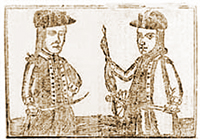
Shays's Rebellion was an armed uprising in Massachusetts in 1786 and 1787. Daniel Shays led four thousand rebels (Shaysites) in rising up against perceived economic injustices.
Daniel Shays and Job Shattuck
from Bickerstaff's Boston Almanack
Three daughters of William Towne and Joanna Blessing were wrongly accused of practicing witchcraft in Salem. Rebecca Towne Nurse, Mary Towne Estey, and Sarah Towne Bridges Cloyes were persecuted in 1692. The children of people in the line below are all descendants of Mary Estey.
Keene, Cheshire County, New Hampshire was settled after 1736 and was a fort protecting Massachusetts during the French and Indian Wars. It was called Upper Ashuelot. When New Hampshire separated from Massachusetts in 1741 it became Keene, New Hampshire.
During King George's War, the village was attacked and burned.
The settlement of New Meadows was incorporated as the Town of Topsfield in 1650. The church "gathered" on November 4, 1663. The third Meeting House was built in 1703 with Rev. Joseph Capen as pastor.
New Hampshire was first settled by Europeans in 1623. It was separated from Massachusetts in 1679.