Thomas2 [Kimball] (Richard1) was born in Rattlesden, Suffolk county, England, in 1633, and was one year old when he came to New England with his parents
He later went to Ipswich, Mass., and was living in Hampton, N. H., October 20, 1653, and was an owner of mill property there on Oyster river. He made his home at that place as late as 1660.
He afterwards removed to that portion of Rowley which is included in the present town of Bradford, Mass. Previous to 1675 the section where Thomas and his brother Benjamin lived was within the limits of Rowley, but the locality was called Merrimack when Thomas was elected a constable on Feb. 20, 1668-9.
His house was one of the legal places for posting and "publishing any orders or other business of public concernment to the whole town." His house was situated on the Boxford Road, and its situation can still be located. At that place he lived and prospered for about ten years. He was a mechanic and a thrifty farmer, owning over four hundred acres of land and a large amount of personal property, as is shown by the inventory of his estate.
At that time the Skelking Indians continually annoyed the white inhabitants. The Merrimack river was a pathway; the Indians could make rapid sallies upon the settlements and make their escape without penetrating the forests. Haverhill had been attacked with all the cruelty of the savages.
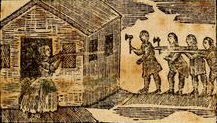
On the night of May 2, 1676, three well known "converted" (half-civilized) Indians, Peter, Andrew, and Symon, were intending to kill some parties in Rowley, but the night being far advanced, they wreaked their vengeance upon the Kimballs. Thomas Kimball was killed by Symon, and his wife and five children, namely Joanna, Thomas, Joseph, Priscilla, and John were taken captive and carried forty miles into the wilderness, where they remained forty-one days, and were freed without ransom by the friendly offices of the chief Wanalancet, of the Pennacook Indians. Her own life and that of her infant were threatened, and twice were the fires lighted to burn them. They reached their home June 13, 1676.
Great was the anguish of their friends during their captivity, and on May 3, 1676, her pious parents in Ipswich asked prayers on the Sabbath that they might be delivered.
Subsequently she addressed a petition to the Governor and Council that she might be protected from Symon, the Indian, who had threatened to kill her and her children if she returned to her own house. The three Indians were seized and confined in jail, but escaped and pursued their course of blood most mercilessly thereafter, and their subsequent fate is unknown. They were semi-civilized and had worked for and lived a great deal with the white people.
The following note from the records at Salem reads
Nov. 18, 1686 Richard and Benjamin Kimball of Bradford did covenant to and with the Selectmen of Ipswich that they would take Thomas Smith and his wife to Bradford to the house of Mary Kimball the widow of Thomas Kimball and provide their Meate, drink, washing, lodging, clothes and attendance with all things necessary for persons in such a condition for the space of one year beginning at the date hereof, the price for a year to be £25.
"Dec. 8 1681 Agreed with Richard Kimball of Bradford to allow unto him further keeping and providing for his grandfather, Thomas Smith for the year ensuing £13.According to this Joanna Smith had probably died during the year.
The name Thomas Kimball occurs very frequently on the early records of the town of Merrimack. Until the time of his death he always held some town office, being frequently selectman.
Inventory of the Estate of Thomas Kimball of Ipswich
Essex
Administration on the estate of Thomas Kimboll, who was slain by the Indians, was granted 27:4:1676, to Mary, the relict, and she was ordered to bring in an inventory to the next Ipswich court.
Salem Quarterly Court Records, Vol 5, leaf 94.
Inventory of the estate of Thom. Kimall, taken May 18, 1676, by Shu. Walker and Samuell Gage:
wearing apparill, all ye Indians left, £1. 10s
Tabel lining, 1 sheete, 3 pillowberes [pillowcase], £1. 15s
vallence and Curtaine and 4 Cushins, 10s
2 Rugs, 2 Blankets, and a parcill of old beading, £3 5s
peatar, £3 3s
1 Iron pot, 1 warming pan, 2 tubs, 2 barills [barrels], £1 10s
saddle and pillion and a parcill of sheeps wool, £1 5s
Tools for his traid and utensils for husbandry, £5
six oxen, five Cowes, two heifers of 3 yere old, 3 steres of 2 yere old, 2
yerlings, 5 Calves, £66 15s
a horse and a mare and a coult, £6
12 swine, £7
7 shepe, £2
housing and about 422 acres land and medow, £450
glass, £1 10s
Corne and provisions, £3
5 yards of Cloath, £1
total £556 3s.
Wearing cloaths of Goody kimballs, £3 16s
cloaths of Joanna Kimball, £2 10s.
Debts due from estate:
Gilbort Wilford's estate, £1
Daniell Boreman, 1£
John Wicom, £1.
Joseph Bond, £1 2s
Ensigne Chandler, £1 10s
by John
Kimball, £12
total, £17 li 12s
Debts due from estate:
Mr. wainwright, £9 18s
Capt. Gerish, £9 9s.
1d.
Sergent Wait, £6 18s
John Pickard, £1 10s
Stephen Webster, £1
10s
Will. Barker, £2 16 s
Deacon Jewit, 18s
David Haseltine, £1 1s
Hunt of Ipswich, £1 2s
Decon Goodhue, £1
Mr Cobbit, 10 s
Shu.
Walker, 12 s
Joseph Hardy, £1 10 s
Nath. Gage, 15 s
Samuel Haseltine, £2
2s
Francis Jordon 2s 6d
Josiah Gage, 18s
John Stickne, £3
Mr.
Buship, at present not known;
Anthony Somersby, £. 5s
Phillip Fouler, 6s
total £50 8s 1d
Attested in Ipswich court Sept 26, 1676 by Mary relict of Thomas Kimball.
Essex County Quarterly Court Files, vol 25, leaf 124.
An inventory brought in, amounting to £520 clear estate was ordered Sept 26, 1676, to the eight children and widow as follows;
to Richard the eldest son, £80, and
to the rest of the children, £40 each, and
the remainder of the estate to the widow,
the land to stand bound for the payment of the children’s portions.