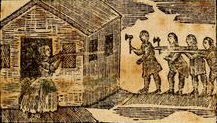
King Philip’s War was a bloody and costly series of raids and skirmishes in 1675 and 1676 between the Native American people and the colonials. King Philip was the Native American leader Metacom.
To be presented to the court meant to be charged or indited.
Lush forests in Colonial America allowed settlers to build wooden homes.
The town common (commons) was a small, open field at the center of the town which was jointly owned. It was used as a marketplace, a place for the militia to drill, or for grazing livestock.
She married Robert Dutch who was born in 1621 in Bridport, Dorset, England. His parents were Osmund (Osmand) and Grace Dutch.
They settled at first in Gloucester and their children were born there.
John Dutch, (1646, married Elizabeth Roper),
Robert Dutch, Jr. (1647, married Hannah Lovel),
Samuel Dutch (1650, married Abigail Gidding),
Mary Dutch Cowes (1652, married Giles Cowes),
Caleb Dutch (1659), and
Benjamin Dutch (1665, married Elizabeth Baker).
Robert was presented at Court in September, 1653,
for reproachfull speeches against mr wm Perkines in a publick towne meeting. Files, Volume II. 86.
In 1656, he sold his holdings in Gloucester to Edward Haraden. The holdings included a house with thirty acres on Planter's Neck, and a barn and orchard with twelve acres on Meeting-house Neck.
When her father died in 1675 she received
ten pounds, five pounds to be payd a year & halfe after my decease, the other five pound the year after that.
Robert was a soldier in King Philip's War of 1675 with Captain Moseley. In the Bloody Brook battle, he was wounded, beaten, stripped, and left for dead, but he recovered.
As Capt Mosely came upon the Indians in the Morning, he found them stripping the Slain, amongst whom was one Robert Dutch of Ipswich having been sorely wounded by a bullet that rased to his Skull and then mauled by the Indian Hatchets, was left for dead by the Salvages, and stript by them of all but his skin...
Mary died on July 12, 1686 and Robert died August 21, 1686.
Mary White Rowlandson,Talcot
was captured by Native Americans
during King Philip's War
(1675-1676).
Rattlesden is a village in Suffolk in eastern England. St. Nicholas church dates from the 13th century. The village was a center of Puritanism in the 16th and 17th centuries.
Old Style Calendar
Before 1752 the year began on Lady Day, March 25th,. Dates between January 1st and March 24th were at the end of the year. Old Style (O.S.) and New Style (N.S.) are used to indicate whether the year has been adjusted. Often both dates are used.
Europeans who made the voyage to America faced a difficult journey of several months.
Women played an essential role in American society as mothers and homemakers.
American colonists continued to use British monetary units, namely the pound, shilling and pence for which £1 (orli) equalled 20s and 1s equalled 12d. In 1792 the dollar was established as the basic unit of currency.
King Charles I ruled England from
March 27,
1625 to 1649.
The Battle of Bloody Brook was on September 12, 1675 between the colonial militia led by Captain Thomas Lothrop and Native Americans. A wagon train carrying the harvest from Deerfield to Hadley was ambushed and about 60 colonists massacred.
Antiquarian Papers, Volumes 1-4 edited by Augustine Caldwell
Every Ipswich boy who had a grandmother to tell him stories, has heard of Robert Dutch who was scalped at Bloody Brook, and came home alive. It will be interesting to those who have only heard the story to see in print, as related by Mr. Hubbard, who received it, probably, from the lips of Robert himself.
Robert Dutch was a son of Osman Dutch of Gloucester who lived to be a hundred years old. Rev. Mr. Hubbard, who wrote the account, lived on Turkey Shore, less than a stone's throw from Sheriff William Dodge's (now Mr. Ploutfs) residence. In our boyhood the cellar of the Hubbard house could be distinctly traced. Mr. Hubbard thus wrote of Robert Dutch who was of that fated company of young men at Bloody Brook, remembered as the "Flower of Essex county:"
As Capt Mosely came upon the Indians in the Morning, he found them stripping the Slain, amongst whom was one Robert Dutch of Ipswich having been sorely wounded by a bullet that rased to his Skull and then mauled by the Indian Hatchets, was left for dead by the Salvages, and stript by them of all but his skin; yet when Capt. Mosely came near, he almost miraculously as one raised from the Dead, came towards the English, to their no small Amazement; by whom being received and cloathed, he was carried off to the next Garrison, and is living and in perfect Health . . .
Another account printed the same year in London gives the following most unlikely version of the affair:
The next day they [the English.] came up againe, the Indians were gone; they had stript the dead Men of all their Clothes, Arms and Horses; amongst which dead was one who had Life in him, and was found by a Friend Indian; he took him up and said, Umb, umb, poo Ingismon, mee save yoo Life, me take you to Captain Mosee. he carries him 15 Miles the Day after to Captain Moseley, and now this Man is well again and in good Health.
The name of Dutch was common in Ipswich till within half a century. An old house on the Seminary Grounds, at the end of the stone bridge was called the "Dutch House."
Various spellings of Kimball:
Kemball, Kembolde, Kembold
History of the Town of Gloucester, Cape Ann: Including the Town of Rockport by John James Babson, Samuel Chandler published by Procter Brothers, 1860
Robert Dutch had a wife Mary, and sons John, Robert, Samuel, and Benjamin, and a daughter Mary, born here. He bought land of John Coit, jun; which he probably improved in fishing and agricultural employments.
In 1656, he sold to Edward Haraden his house and thirty acres of land on Planter's Neck, with the stage, and all appurtenances belonging to it; and twelve acres upon the Meeting-house Neck, with a barn and orchard; the whole comprising all his possessions in Gloucester.
He afterwards lived in Ipswich, and was a soldier in the Indian war of 1675. In one of the skirmishes with the savages, he was wounded, beaten, stripped, and left for dead; but he recovered, and was soon joined and relieved by bis friends. He died before 1691.
European and indiginous American fought fierce battles as the Europeans expanded their territory.