The settlement of New Meadows was incorporated as the Town of Topsfield in 1650. The church "gathered" on November 4, 1663. The third Meeting House was built in 1703 with Rev. Joseph Capen as pastor.
Joseph Towne was born in 1639 and baptized on September 3, 1648 in St. Nicholas Parish, Great Yarmouth, Norfolk County, England. His parents were William Towne and Joanna Blessing.
Joseph and Phebe's children included:
Phebe Towne (1666, died age 2),
Joanna Towne (1667/68, married Thomas Nichols),
Mary Towne (1670),
Susannah Towne Cummings (1671, married John Cummings),
Joseph Towne (1672/73, married Abigail Curtis),
Sarah Towne (1675),
John Towne (1677/78), and
Martha Towne Leach Larrabee (1680, married Isaac Leach and Isaac Larrabee).
Joseph died in 1713 in Topsfield.
Three daughters of William Towne and Joanna Blessing were wrongly accused of practicing witchcraft in Salem. Rebecca Towne Nurse, Mary Towne Estey, and Sarah Towne Bridges Cloyes were persecuted in 1692. The children of people in the line below are all descendants of Mary Estey.
Old Style Calendar
Before 1752 the year began on Lady Day, March 25th,. Dates between January 1st and March 24th were at the end of the year. Old Style (O.S.) and New Style (N.S.) are used to indicate whether the year has been adjusted. Often both dates are used.
Mary Towne Estey was a victim of the Salem witch delusion on September 22, 1692.
Early European settlers in the American colonies were mostly farmers and craftsmen. They had to work hard to provide daily neccesities for themselves.
Learn more about the Towne family.
from The New England Historical & Genealogical Register by New England Historic-Genealogical Society, 1867
Joseph Towne, youngest son of William and Joanna Towne, was b. about 1639, and m. Phebe, dau. of Dea. Thomas Perkins, of Topsfield. He accompanied his father in his removal from Salem to Topsfield; was made a freeman, March 22, 1690; was a member of the church at the latter place, and d. 1713, aged 74 years.
Children:
Phebe, b. May 4, 1666.
Joanna, b. Jan. 22, 1668; m. Thomas Nichols, Dec. 15,1691.
Mary, b. March 27, 1670.
Susannah, b. Dec. 24, 1671.[married John Cummings]
Joseph, b. March 22, 1673.
Sarah, b. Dec. 30, 1675.
John, b. Feb. 20, 1678.
Martha, b. May 19, 1680.
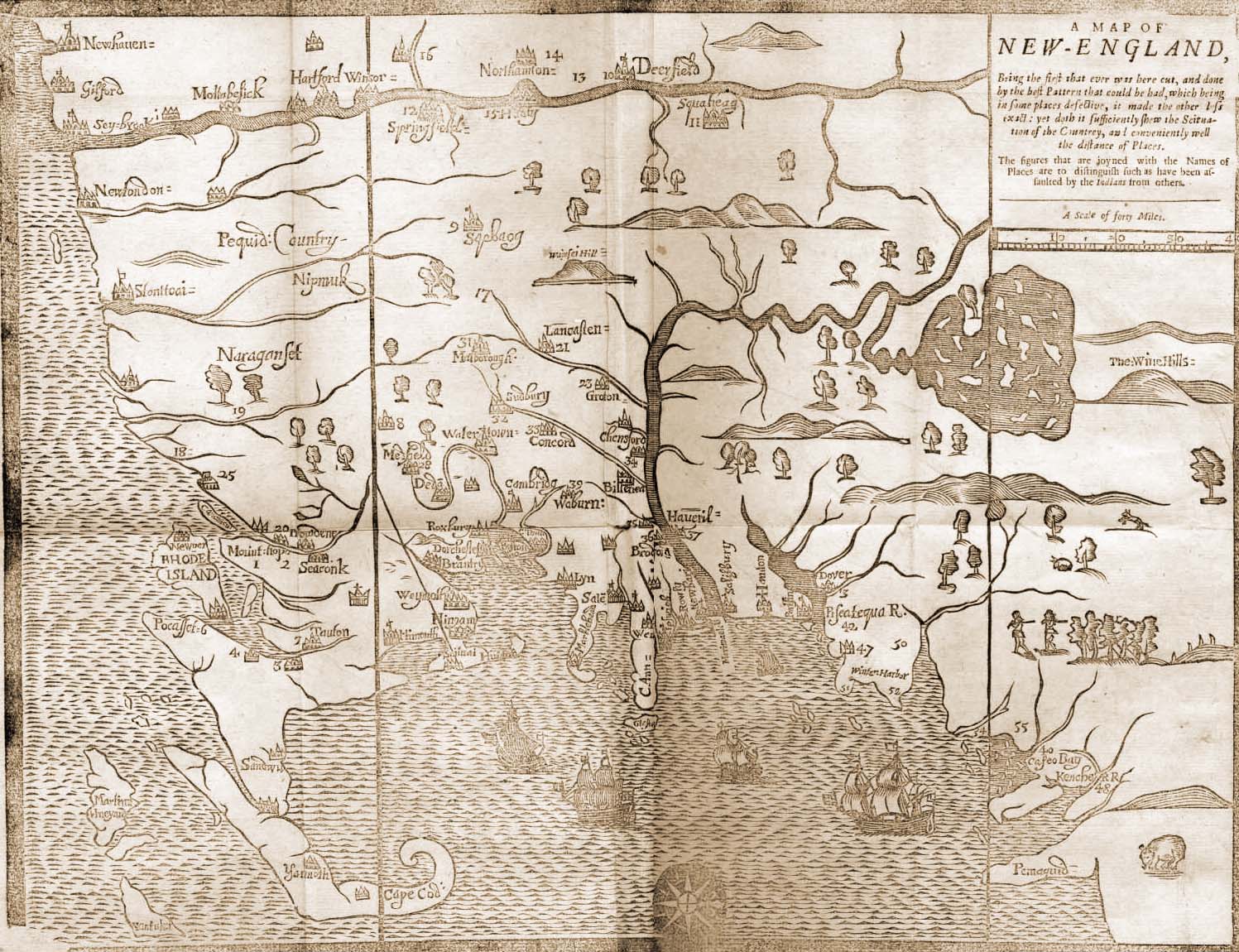
1677 Map of New England
click to enlarge
Any man entering a colony or becoming a a member the church, was not free. He was not forced to work, but his movements were carefully observed to see if they followed the Puritanical ideal. After this probationary period, he became a "freeman." Men then took the Oath of a Freeman where they vowed to defend the Commonwealth and not to overthrow the government.