logo

An American Family History

Daniel Richards

In the 17th century jails were used as places to hold people accused of crimes until they were brought to trial, but not as places of punishment. A debtor could be held in jail until he paid his debts and political dissidents were also jailed. Punishments included execution, maiming, public humiliation and monetary fines.

During the 17th and 18th centuries an adult unmarried woman was considered to have the legal status of feme sole, while a married woman had the status of feme covert. A feme sole could own property and sign contracts. A feme covert was not recognized as having legal rights and obligations distinct from those of her husband and could not own any property. When a woman became a widow she became a feme sole again.

Daniel Richards was born in 1665 in Lynn, Essex County, Massachusetts. His parents were parents were Edward Richards and Ann Knight.

He married Elizabeth Bassett Proctor on September 22, 1699 in Lynn. Elizabeth was born in 1650. She was daughter of Captain William Bassett and Sarah Burt. 

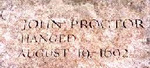
She was John Proctor’s second wife. John was born in England in 1632. His first wife was Elizabeth Thorndyke. John and Elizabeth married April 1, 1674. They had six children. John Proctor was hanged for witchcraft in Salem on August 19, 1692.

John Proctor
John Proctor's Tombstone

Elizabeth was put in prison with John, but was given a reprieve "on account of her peculiar circumstances" or until her child could be born. This child, John Proctor, was born in prison January 27, 1693 and died in Danvers in 1774.

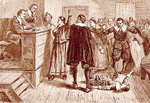
trial
Elizabeth and John Proctor at trial.

When she was set free, she and her children were impoverished. Because she had been condemned to death she was considered legally dead she could not claim her husband's property.


Settlers from Salem purchased land in an area known as Saugus from the Indians. This land originally included the towns of Swampscott, Nahant, Saugus and Lynnfield. In 1630 the land was incorporated as the Town of Saugus. The settlers changed the name to Lynn in 1637 in honor of their first official minister, Samuel Whiting, from King’s Lynn, England.

Children of
Edward Richards

Ann Knight Richards
  • John Richards
  • Abigail Richards Collins
  • Mary Richards Nick
  • William Richards
  • Deborah Richards
  • Daniel Richards
  •  

    Memorial biographies of the New England Historic Genealogical ..., Volume 9

    The Proctor family in this country is descended from John Proctor, who came in 1635 from London, in the ship "Susan and Anne," at the age of forty, with his wife Martha, aged twenty eight, and two children, — John, aged three years, and Mary, aged one year. He settled in Ipswich, and later removed to Salem. He died, probably in 1672, as his will was proved in November of that year. He left seven children.

    His son, John [Proctor], born in England about 1632, married, in 1662, Elizabeth Thorndyke, and after her death married Elizabeth Bassett. He had nine children.

    During the excitement relating to witchcraft in 1691 and 1692 his second wife was accused of being a witch, and was brought to trial and condemned. Her husband, "for showing proper regard to her," as Hutchinson says, fell under suspicion of the same crime, and was also tried and condemned. (See Hutchinson, vol. ii, pp. 25 and 55.) He was put to death August 19, on what is now known as Gallows Hill, Salem.

    His wife was reprieved on account of her pregnancy, and before the reprieve expired, the excitement had so far subsided that she was not executed. Two, or perhaps three, of their children were also sent to prison under suspicion of the same crime, but they were discharged without a public trial. Four years later the Legislature had to be petitioned to order the release of her husband's property from forfeiture. (See Felt, vol. ii, 484.) It has been suggested that the charge of witchcraft was brought against Mr. Proctor on account of his sturdy opposition to the views then prevailing in respect to witchcraft. Dr. Nichols, who wrote the historical poem for the Centennial day of the town of South Danvers, has this couplet of the Proctor family: —

    "The Proctors, they say,
    Will have their own way."


    History of Lynn, Essex County, Massachusetts: Including Lynnfield, Saugus, Swampscot, and Nahant by Alonzo Lewis, James Robinson Newhall Published by J. L. Shorey, 1865


    William Basset was a farmer, and died 31 March, 1703. He had two sons; William, who married Sarah Hood, 25 Oct. 1675; and Elisha, whose wife's name was Elizabeth. His descendants remain. [He lived on Nahant street, on land which is still (1863) in possession of his descendants. He married Sarah, daughter of Hugh Burt, who died in 1661. He was an ensign in the company of Capt. Gardner, of Salem, in the Indian war, and was at the "swamp fight." For his services, the General Court made him a grant of land. Capt. William Bassett, supposed to be the same individual, was one of a council of war, with Major Benjamin Church, at Scarborough, Me. 11 Nov. 1689. His name often appears in the oldest town records of Lynn, where, in 1691, he is called Quartermaster Bassett. He died 31 March, 1703.

    His son William [Bassett], who married Sarah Hood, as stated above, by Mr. Lewis, succeeded to the estate. This Sarah [Hood Bassett] was the same person spoken of under date 1692, as having been imprisoned for witchcraft. He also had a daughter Elizabeth [Bassett], who married John Proctor, of Danvers, who was executed for witchcraft. She was condemned, but pardoned. She had a second husband, named Richards.

    His children, besides those named, were
    Sarah, who married Thomas Elwell, of Gloucester, in 1675, and in 1701 lived in Salem county, N. J.;
    Rebecca; John, born in 1653;
    Miriam, b. 1655;
    Mary, b. 1657, who was also imprisoned for witchcraft, in 1692;
    Hannah, b. 1660, who married John Lilley, of Woburn;
    Samuel, b. 1664; and
    Rachel, b. 1666, who married Ephraim Silsbee.


    ©Roberta Tuller 2012
    tuller.roberta@gmail.com