A Puritan was a member of the religious group in the 16th and 17th centuries that advocated "purity" of worship and doctrine who believed in personal and group piety. Puritans were persecuted in England and came to America so they would be free to practice their religion.
Mary Fuller Williams was baptized on June 16, 1644 in Barnstable or Scituate. She was the daughter of Samuel Fuller and Jane Lothrop.
She married Joseph Williams on November 18, 1674. Joseph was born on April 18, 1674 in Haverhill, Essex County, Massachusetts. He was the son of John and Jane Williams.
Mary and Joseph's children included:
Sarah Williams Roath (1675, married John Roath),
Mary Williams (1677),
John Williams (1680, married Mary Knowlton), and
Hannah Williams (1683).
In 1683 Mary inherited from her father, Samuel Fuller, “four pound in Money and two Cowes" and “all my household stuffe to be equally Dvided" with her three sisters.
By 1687 the family had settled in Norwich, Connecticut on Poquetannock Cove, Brewster's Neck.
In 1703 Joseph was a member of the first Congregational Church of Norwich.
Joseph died before Mary who died in 1720 near Norwich, Connecticut.
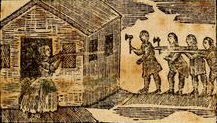
Mary White Rowlandson,Talcot
was captured by Native Americans
during King Philip's War
(1675-1676).
Barnstable, Massachusetts was settled in 1639 when Parson Joseph Hull came to Cape Cod with and his congregation from Weymouth. A little later in the year, the Reverend John Lothrop brought his Congregationalists. They incorporated as the Town of Barnstable.
Connecticut's first European settlers were Dutch.
King Philip’s War was a bloody and costly series of raids and skirmishes in 1675 and 1676 between the Native American people and the colonials. King Philip was the Native American leader Metacom.
Eastern Long Island was settled at Southold by English Puritans on October 21, 1640. Western Long Island was Dutch. The Conklins and other related families owned the entire area in the 17th century. The Dutch granted an English settlement in Hempstead (now in Nassau) in 1644. In 1664, the Dutch colony of New Amsterdam became English and was renamed New York.
New London County, Connecticut was one of four original Connecticut counties and was established on May 10, 1666, by an act of the Connecticut General Court.
Ancestry of Lawrence Williams 1708-1767 by Cornelia Bartow Williams published by R.R. Donnelley and Sons Co., 1915
Joseph Williams (John1) was born in Haverhill, Mass., 18 Apr., 1647, and died in Norwich, Conn., 1719-20. His father conveyed to him property in Haverhill thus recorded 14 July, 1673:
to my sonne Joseph Williams my now dwelling house, out housing, house lott, oarcheard and hopp yards, ye are upon ye sd lott, together with eight comonages wch I have in ye sd towne of Haverhill, and also ye prcell of comon land wch was layd out to me beyond the fishing river towards the saw mill, and also my Duck meadow wch is bounded at ye south end with two oakes and at ye north end with a swamp.
After the birth of his youngest child in 1683 his name is found no more in the records of Haverhill. The next trace of him is gathered from the archives of Norwich, Conn. Here he settled on Poquetannock Cove, Brewster's Neck, on the extreme boundary line of the southern limits of old Norwich, east of the Thames, just within what was comprehended in the original Indian grant of the "nine miles square tract". . . We have no present means of determining the exact date of his removal to Connecticut; but it was before 1697, for on that date mention is found on the town records of the conveyance to him of fifty acres of land by Josiah Gaylord of Poquetannock.
Although we have no direct knowledge of the motives or reasons that induced the exodus from Haverhill to the neighborhood of Long Island Sound, we are acquainted with circumstances enough to answer our query satisfactorily as to why he took the step.
About this time a fellow townsman of his, one Gurdon Saltonstall, who afterwards became governor of the State of Connecticut, had accepted a call to minister to a flock in New London. Many others of his townspeople had emigrated thitherward; some of his wife's relatives were also located there, and possibly from that source he learned that the land was much more productive near the banks of the Thames than on those of the Merrimac.
Another incentive to removal from Haverhill at this particular juncture was a political one. Governor Andros, who had just been put at the head of affairs in the Bay Colony, began by imposing fines and exacting from the freemen their hard-earned money. Connecticut was out of his province, and there one was able to escape such annoyances.
Last, but by no means least, was the fact that Haverhill was a frontier settlement, which was constantly menaced by the Indians. Since the close of King Philip's War in 1676, the country of southern New England had been enjoying peace and security, while the borderland of New Hampshire, now that the French and Indian war was rife, was ever and anon a scene of desolation. It is not to be wondered at that the dwellers in that vicinity should have desired to move to a more peaceful location. In 1694 a law was passed by the Massachusetts Bay Colony that every settler who deserted a town for fear of the Indians should forfeit all his rights therein. Evidently the towns on the frontier were already losing their population. . .
Every newcomer who succeeded in being publicly accepted obtained a grant of land comprising a building lot, pasture ground, and woodland sufficient for a family. So, in 1702, we learn that a vote was taken at a town meeting of Norwich, putting certain names on the Roll as an addition to its inhabitants, and in the number Joseph Williams was entered as "a wholeshare man respecting lands."
In 1703 he was a member of the first Congregational Church of Norwich. The Norwich town records mention many real-estate transactions of Joseph Williams, which show that he was a man in prosperous circumstances and that his business interests were in partnership with his son John. A roll of landed proprietors is given in 1718, which mentions him; and the record of a deed bearing date of March, 1719, is in his name. In 1720, the year of his wife's death, he is referred to as deceased. He left but one son to carry down the Williams name.
He married in Haverhill, Mass., 18 Nov., 1674, Mary Fuller, baptized in Barnstable, Mass., 16 June, 1644, and died in Norwich, Conn., ii Nov., 1720; daughter of Samuel Fuller (who came with his father Edward Fuller on the Mayflower) and Jane, his wife, daughter of Rev. John Lothrop, of Barnstable, Mass.
Children born in Haverhill
1. Sarah, b. 17 Nov., 1675.
2. Mary, b. 29 Nov., 1677.
3. John, b. 17 Feb., 1679/80
4. Hannah, b. 30 Sept., 1683.
A sawmill was an important developmental step in a community. Before sawmills, boards could only be sawn by two men with a whipsaw. In a sawmill, the circular motion of a water wheel was changed to the back-and-forth motion of the saw blade with a pitman arm.
Understand the Puritans better:
The Massachusetts Bay Company was a trading company chartered in 1629 to settle an English colony in New England. Puritan leaders saw it as a religious and political refuge. About 900 colonists arrived in 1630.
Colonial legislatures granted land to a group of settlers (proprietors) who chose how to divide the land. They had some rights of governance.
European and indiginous American fought fierce battles as the Europeans expanded their territory.