“Remember, remember always, that all of us, and you and I especially, are descended from immigrants and revolutionists."
― Franklin D. Roosevelt
King Charles I ruled England from
March 27,
1625 to 1649.
European and indiginous American fought fierce battles as the Europeans expanded their territory.
American colonists continued to use British monetary units, namely the pound, shilling and pence for which £1 (orli) equalled 20s and 1s equalled 12d. In 1792 the dollar was established as the basic unit of currency.
Lush forests in Colonial America allowed settlers to build wooden homes.
Hannah Bradstreet Rolfe Holt was born in 1625 in England. Her parents were Humphrey and Bridget Bradstreet. When she was nine years old she came to America with her family.
When she was 25, she married her first husband, Daniel Rolfe (Roff, Roffe) in 1650. Daniel was born in 1621. His parents were not Ezra Rolfe and Abigail Bond. They were born after he was.
Daniel and Hannah's children included:
Hannah Rolfe (1652) and
Daniel Rolfe (1655, married Mary Knight).
According to the Essex Antiquarian in the court of June 3, 1651
Joseph Muzye fined for lying and for saying, when some one was reading that it was the devil's service book.
Witness: Daniell Rofe.
Her father mentioned her in his will
Item I doe give to my daughter Hannah Rofe 20 (twenty) pound.. . . [and] to my two grand choldren Daniel and Hannah Rofe each of them five pound to be paid out of the farme by my sonne Moses when they attain the age of 21 years.
Daniel, Sr. died in 1654 before Daniel, Jr. was born. He was only 34 years old.
The inventory of his estate gives us a fascinating glimpse of their lives. Although Hannah was made the administratrix of the estate, all the the family's assets were listed because they belonged to her husband since a married woman could not own property in her own name.
She married her second husband, Nicholas Holt (Holton), on June 12, 1658. She was his second wife. His first wife was Elizabeth Short. Nicholas was born in 1602 in England. He manufactured woodenware and called himself a "dish turner." On the ship roll he was listed as a tanner which could be a misreading of turner.
Nicholas and Hannah's children included:
Rebecca Holt (1662) and
John Holt (1664).
She died on June 20, 1665 when she was 40 years old. After her death, Nicholas married Mrs. Martha Preston, the widow of Roger Preston on May 21, 1666.
Their son, Daniel Holt, was killed December 19, 1675 during the attack on the fort at Narragansett.
Nicholas died January 30, 1684/85 in Andover, Essex County, Massachusetts.
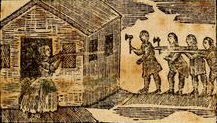
Mary White Rowlandson,Talcot
was captured by Native Americans
during King Philip's War
(1675-1676).
During the 17th and 18th centuries an adult unmarried woman was considered to have the legal status of feme sole, while a married woman had the status of feme covert. A feme sole could own property and sign contracts. A feme covert was not recognized as having legal rights and obligations distinct from those of her husband and could not own any property. When a woman became a widow she became a feme sole again.
Old Style Calendar
Before 1752 the year began on Lady Day, March 25th,. Dates between January 1st and March 24th were at the end of the year. Old Style (O.S.) and New Style (N.S.) are used to indicate whether the year has been adjusted. Often both dates are used.
Rowley, Essex County, Massachusetts was first settled in 1639.
Early European settlers in the American colonies were mostly farmers and craftsmen. They had to work hard to provide daily neccesities for themselves.
Estate inventories give us a glance into the home life of Colonial Americans.
The Great Swamp Fight was on November 2, 1675. Josiah Winslow led a force of over 1000 colonial militia and about 150 Pequot and Mohegan warriors against the Narragansett. Several abandoned Narragansett villages were burned and the tribe retreated to a five acre fort in the center of a swamp near Kingston, Rhode Island. The fort, which was occupied by over a thousand indigenous warriors, was taken after a fierce fight. It was burned and the inhabitants, including women and children, were killed or evicted. The winter stores were destroyed. The colonists lost about 70 men and nearly 150 were wounded.
Goodman was a courtesy title before the surname of a man not of noble and Goodwife or Goody was the courtesy title for a married woman not of noble birth.
Tools were an important legacy because they were essential part of daily life.
Mister ( Mr.) was derived from master and Mrs. and Miss were derived from mistress. They indicated people of superior social status in colonial America.
Anne Dudley Bradstreet (1612-1672) was the first women poet published in America and England. She was the wife of Governor Simon Bradstreet.
Estate Of Daniel Rolfe Of Ipswich
Administration on the estate of Daniell Rolf of Rowley, intestate, granted 27: 4: 1654, to his widow, Hannah Rolf.
Salem Quarterly Court Records, vol. 3, leaf 73.
Inventory of the estate of Daniell Rofe of Ipswich, deceased taken June 24, 1654, by Daniel (his D mark) Thurston, John (his I mark) Gage and Robert Lord:
One bedsted & cord, 1 li.;
a little flock-bed & boulster,
an ould Rugge & blanket, 2 paire of sheetes, 16s.;
His weareing apparell, 3 li. 10s.;
a little table and 2 chaires, 2 little stooles, 12s.;
one Cradle, 4s.;
a warmeing pan, 4s. 6d.;
1 skillet & brase ladle, . 3s. 6d., 8s.;
one Iron pot, 8s.,
1 dozzon of trenchers [wooden plates], 12d., 9s.;
one square, 3 agures [auger], a broad axe & a pr. compasses, 12s.;
felling axes & one howe [hoe], 5s.;
other Tooles & an ould sithe [scythe] & one hinge, 12s.,
another ould sithe & snath, 2s. 6d.;
a hat brish [brush] axe, a pr. of sisers [scissors] and an ould tubb, 2s.;
a fowling peece [a light shotgun], 1li. 13s. 4d.;
one box, 4s.,
1 houre glass, 1s., 5s.;
1 beetle [mallet], 20d.,
one Iron pot, 10s., 11s. 8d.;
an ould bible & one other booke, 6s.;
one little kettell & a little skillet, 6s.;
2 sives [sieve], 2s.;
one earthen pot, 4 spoones, 20d., 3s. 8d.;
4 little keelars [keeler=small tub], 7s.,
one little pondering tub, 3s., 10s.;
1 ould chirne [churn], one runlet [small stream] bucking [washing method] tub & firkin [small cask], 9s.;
one bottle & other wooden ware, 5s. 6d.;
one earthen pot & 20 li. of butter, 10s.;
5 cheeses, 4s.;
a pr. of wood in scales & earthen weres, 6s.;
an acre of Rye on the ground, 1li.;
4 acres of Indian corne slit corne, 3li.;
about 9 acres of wheat & barlye, 1 6li.;
a paire of oxen, 16 li. 5s.,
1 cart & plough, 32s., 17li. 17s.;
a cowe & a calfe, 6li.;
one asse, 5li., 11 li.;
one small sow & 2 piggs, 1li. 10s.;
a raper [rapier=sword], 22s.,
belt, 2s., 1li. 4s.;
powder & shot, 18d.;
a drum & sticks, 2li.;
a little fowleing peece, 1li.;
a chaire, 18d., 1s. 6d.;
owing to the estate, 3li.;
the grass that is to be mowne, 1li 12s.;
3li. of yarne, 5s.; total, 74li. 17s. 8d.
Debts due:
To Mr. Jewet [Jewett], 1 li., & he requires 9 li. more for damages,
20li.;
to my father, Humphry Broadstreet,
11 li.;
to Goodman Weekes of Salem,
6 li.;
to John Woodam,
6li. 10s.;
to Goodman Thurston,
1 li. 19 s.;
to John Gage,
3 li.;
to Mr. Baker,
10 s.;
to Nath. Stow,
40 s., 2 li. 10s.;
to Goodwife Elitrip & Marke Quilter,
2li.;
to Lieft Remington,
12s.,
to Goodman Kemball [Kimball],
12s., 1li. 4s.;
to Mr. Payne,
4s. 6d.,
to John Tod,
24s., 1li. 8s. 6d.;
to Goodwife Lumkin,
3s.;
to William Beale,
4li.;
to Major Denison,
10s. 6d.; total, 60li. 5s.
Essex Co. Quarterly Court Files, vol. 2, leaf 134.
Cattle were vital to a household and an important legacy.
Unweaned cattle are calves.
Female cattle are heifers and cows (had a calf).
Male cattle are steers (castrated) and bulls.
Oxen are trained draft animals and are often castrated adult male cattle.
A flock bed [mattress] is stuffed with waste wool or cotton.
It was common for bequests to include wearing apparel.
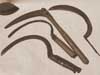
A scythe or a sickle is a hand tool for reaping crops. The handle of a scythe is a snead.
A bed warmer or warming pan is a metal container with a handle which was filled with hot coals and placed under the bedcovers to warm the bed.
An auger is a tool for boring holes in wood.
Indian Corn (or flint corn) is the type of maize that Native Americans taught colonists to cultivate. The kernels come in a range of colors and are less prone to spoiling.
The Genealogical Bulletin, Volume 1, October 10, 1903
Daniel Roffe of Rowley and Ipswich married Hannah Bradstreet. He was father of Daniel who was slain by Indians 19 Dec., 1675 at the attack on the fort at Narragansett.
A tanner treats animal skins to produce leather. After the tanning process, the currier dresses, finishes and colors the tanned hide.
Historic Homes and Institutions and Genealogical and Personal Memoirs of Worcester County, Massachusetts by Ellery Bicknell Crane, Lewis Publishing, 1907
Nicholas Holt, the pioneer ancestor of Mrs. William H. Hobbs, was born in England, in 1602. He came from Romsey, England, in the ship James, William Cooper, master, sailing April 6, and landing in Boston June 3, 1635.
He was one of the first settlers at Newbury and Andover, Massachusetts. At Newbury he was husbandman, proprietor and town officer. He made a long journey with others to take the freeman's oath May 17, 1637, and vote against Sir Harry Vane. He was a tanner as well as a farmer. He removed to Andover in 1644. He sold his Newbury land November 14, 1652. He is called a plate-turner (woodworker) in some records.
He married (first) Elizabeth. She died at Andover, November 9, 1656. He married (second), June 20, 1658, Hannah (Bradstreet) Rolfe, widow of Daniel Rolfe and daughter of Humphrey Bradstreet. She died June 20, 1665. He married (third) Mrs. Martha Preston, widow of Roger Preston, May 21, 1666. She died March 21, 1703, aged eighty years. He died January 30, 1685, aged eighty-three years.
Children of Nicholas and Elizabeth Holt:
Hannah, born in England, married Robert Gray;
Elizabeth, born at Newbury, March 30, 1636;
Mary, born at Newbury, October 6, 1638;
Samuel, October 6, 1641;
Henry, born 1644, of whom later;
Nicholas, 1647;
James, 1651;
Priscilla, June 20, 1653.
Children of Nicholas and Hannah Holt were:
Rebecca, born November 14, 1662;
John, January 14, 1663-4.
Colonial legislatures granted land to a group of settlers (proprietors) who chose how to divide the land. They had some rights of governance.
The rod or perch or pole is a surveyor's tool equal to 5 1⁄2 yards.
Any man entering a colony or becoming a a member the church, was not free. He was not forced to work, but his movements were carefully observed to see if they followed the Puritanical ideal. After this probationary period, he became a "freeman." Men then took the Oath of a Freeman where they vowed to defend the Commonwealth and not to overthrow the government.
from Genealogical and Family History of the State of New Hampshire by Lewis Publishing Company, Chicago
Nicholas Holt was a passenger on the ship James, of London, William Corner, master, which sailed from the port of Southampton. England, about April 6, 1635, and arrived at Boston, in New England, on June 3 following, after a voyage of thirty-eight days. The names of fortythree male persons are found as passengers on the ship's roll, "besides the wives and children of Dyvers of them." Among the former occurs the name of Nicholas Holte, of Romsey, (county of Hants) England, "tanner." He was undoubtedly accompanied by his family, which consisted of a wife and at least one child.
He proceeded the same year to Newbury, where he was one of the first settlers, and resided there for a period of ten years. There he received his proportionate share of the lands allotted to each proprietor. In 1637 his name appears as one of the ten persons who in order to vote to prevent the re-election of Sir Henry Vane to the office of Governor, and to strengthen the friends of Governor [John] Winthrop, went from Newbury to Cambridge on foot, forty miles, and qualified themselves to vote by taking the freeman's oath May 17, 1637. This defeat was a severe blow to the pride of Sir Henry Vane.
April 19, 1638, Nicholas Holt was chosen one of the surveyors of the highways "for one whole yeere & till new be chosen." February 24, 1637, it was
agreed that Wm. Moody, James Browne, Nic. Holt, ffrancis Plummer, Na Noyse shall lay out all the generall fences in the towne that are to be made, as likewise tenn rod between man & man, for garden plotts, this to be done by the 5th of March on the penalty of 5s apiece.
In the month of June, 1638, all the able bodied men of Newbury were enrolled and formed into four companies under the command of John Pike, Nicholas Holt, John Baker, and Edmund Greenleafe. They were required
to bring their arms compleat one Sabbath day in a month and the lecture day following," and "stand sentinell at the doores all the time of the publick meeting."
The first church records of Newbury prior to 1674 are lost and consequently the name of Nicholas Holt is not found, but it appears in the following order of the town records:
Jan. 18, 1638. It is ordered that Richard Knight, James Brown & Nicholas Holt shall gather up the first payment of the meetinghouse rate & the towne within one fourtenight on the penalty of 6s 8d a piece.
In 1644 Nicholas Holt was one of the ten original settlers who removed their families from Newbury and accompanied their pastor the Rev. John Woodbridge to "Cochichawicke," now Andover. On a leaf in the-town records containing the list of householders in order as they came to the town his name is sixth.
He was one of the ten male members including the pastor elect who composed the church at the ordination of Mr. John Woodbridge, October 24, 1645. May 26, 1647, he was appointed in connection with Sergeant Marshall
to lay out the highway from Reading to Andover. and with Lieut. Sprague and Sergeant Marshall to view the river (Epswich river) and make return to the court of the necessity and charge of a bridge and make return to the next session of this court.
At a general court held May 2, 1652, he was appointed with Captain Johnson of Woburn, and Thomas Danforth, of Cambridge, "to lay the bounds of Andover."
and May 18, 1653, he was appointed with Captain Richard Walker and Lieutenant Thomas Marshall to lay out the highway betwixt Andover and Reading and at the same term of Court, September 10, 1655, the committee made a report of said survey.
Nicholas Holt lived to a good old age and died at Andover, January 30, 1685, aged one hundred and four years, says the record, but Coffin, with more probability, says eighty-three. In his early life he carried on the business of manufacturer of woodenware. A few years before his death, in distributing his property among his children, he styles himself "dish turner." The word "tanner" on the roll of the ship James is probably an error of the recording official who mistook the word turner for tanner.
There is no doubt but that the same motives that actuated the other early settlers of New England in leaving their pleasant homes in England and emigrating to this country, had their due influence on him. That he was a religious man is made evident by the fact that he was one of the original members of the Andover church, and by his forsaking his native home in England, to encounter the privations and difficulties of the wilderness in order that he might enjoy the privilege of worshipping God according to the convictions of his own mind and his understanding of God's word. While honestly and conscientiously discharging his duties in this regard, he took an active part in public affairs of the town, and his appointment on important committees in laying out roads and other improvements indicates that his services were valuable and appreciated.
Nicholas Holt was married in England, a few years before he came to Massachusetts. The name of his wife was Elizabeth Short, of whom nothing more is known than that she died at Andover, November 9, 1656.
He married second, June 20, 1658, Hannah, widow of Daniel Rolfe, and daughter of Humphrey Bradstreet. She died June 20, 1665, at Andover,
and he married third. May 21, 1666, Widow Martha Preston, who died March 21, 1703. aged eighty years.
He had by his first wife, four sons and four daughters; by his second wife, one son and one daughter. His children born in Newbury were: Elizabeth, Mary, Samuel, Andy; and in Andover, Henry, Nicholas, James, John, and Priscilla.
John Winthrop (1587/8 – 1649) was a leading figure in the founding of the Massachusetts Bay Colony. He led the first migrants from England in 1630 and served as governor for twelve years. His vision of the colony as a Puritan "city upon a hill" dominated New England's development.
The New England Meetinghouse was the only municipal building in a town. Both worship and civil meetings were held there. It was customary for men and women to sit separately and the town chose a committee once a year to assign seats according to what was paid, age, and dignity.