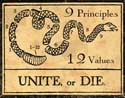
"[L]iberty must at all hazards be supported.
We have a right to it, derived from our Maker.
But if we had not, our fathers have earned and bought it for us,
at the expense of their ease, their estates, their pleasure, and their blood."
-- John Adams, 1765
A Trainband (or training band) was the basic tactical unit of the colonial militia. Men were required to join the local trainband. In wartime, military units were formed by selecting men from the trainband.
New Jersey's first permanent European settlement was in 1660.
She married Edward Slater in Piscataway. Edward was born about 1644.
Edward was put in prison in 1681 for speaking out against the governor. The History of Middlesex County, New Jersey states that Edward Slater was a freeholder in the township in 1683, and owned a large number of acres. He was the first clerk of the courts of the county.
Elizabeth and Edward's children included:
Filoretta Slater (1691, married Benjamin Martin),
Phebe Slater (1693, married James Doty),
Caleb Slater (1695),
Elizabeth Slater (1697),
Abraham Slater (1700), and
Aleeshia Slater (1702, married Henry Skibbo).
In 1699/1700, Elizabeth's sister Priscilla's husband, John Langstaff, and Edward Slater were involved in anti-English, pre-revolutionary activities. The court wanted to hold proceedings in the Piscataway Public house. The townspeople were opposed to this and nailed the door shut. The sheriff attempted to break the door open and John and Edward stopped him forcibly. One account of this incident is below and another is on the Priscilla and John Langstaff page.
The inventory of the estate of Edward Slater was made on February 11, 1702/03 and was made by George Drake and Thomas Grub. It amounted to £94.6.10. On May 29, 1704, administration was granted to his widow, Elizabeth Slater.
A freeholder is the owner of a freehold estate which is an interest in land that is not fixed by a specified period of time, but which may last during the lifetime of a person.
In the 17th century jails were used as places to hold people accused of crimes until they were brought to trial, but not as places of punishment. A debtor could be held in jail until he paid his debts and political dissidents were also jailed. Punishments included execution, maiming, public humiliation and monetary fines.
Piscataway Township in New Jersey was first settled in 1666 by Quakers and Baptists who had left the Puritan colony in New Hampshire.
Women played an essential role in American society as mothers and homemakers.
The American Revolutionary War (1775–1783) was between the Kingdom of Great Britain and the 13 colonies which became the newly formed United States.
The Story of an Old Farm, Or, Life in New Jersey in the Eighteenth Century, by by Andrew D. Mellick, published by Unionist-Gazette, 1889
Edward Slater, another old settler, seems early to have "come to grief;" we learn from the town records that he was imprisoned in 1681 for having
uttered very pnishouse and Squerillouse words Rendering the Government of the province, the Governor and Counsell Odyous in the Eyes and hearts of the peopl.
. . .Slater did not, apparently, remain in durance very long, as in 1683 he was again apprehended on the suspicion of being an escaped criminal from England, and in the same year was presented by the grand jury in an indictment of nine counts, "as a common nuisance and offence."
Notwithstanding the tribulations of Edward Slater, by 1685 he seems to have been entirely restored to public favor. In that year he, with Hopewell Hull, John Fitz-Randolph, and others, was appointed one of a committee to superintend the building of a church edifice, the selectmen having on the eighteenth of January, 1685-6, passed the following resolution:
At the Towne Meetinge then agreed yt there should be a meetinge house built forthwith, the dimentions as followeth: Twenty foot wide, thirty foot Longe, and Ten foot between joynts.
To be presented to the court meant to be charged or indited.
ye is an archaic spelling of "the."
The town clerk was one of the first offices in colonial America. The clerk recorded births, marriages, and deaths.
East Jersey Under the Proprietary Governments by William Adee Whitehead, published by M. R. Dennis, 1875
At the Court of Sessions held at Elizabethtown, March, 12th 1699/1700, ...Samuel Carter, in the words of the record,
in an Insolent and contemptuous manner Railed and disowned the authority and form of the Court and...and grossley abused the King's Attorney Generall and used and utterred words and Actions wholly unfitt to be mentioned...
The High Sheriff was directed to arrest Carter and not allow him to be bailed and the Court adjourned
with almost General noise and hollowing, with unseemly actions and Insolent gestures which seemed Rather to Look like a Rebellion than otherwise. ...
A week later, on the 19th March, 1700, the Court... convened at Piscataway... but they found the doors of the public meeting house closed against them. On their demanding the keys, they were told that the house belonged to the town, and as entrance was refused the Sheriff was commanded to break open the door. Upon his attempting to do so, he was assaulted by Edward Slater and John Langstaff, while other persons stood by and obstructed him. He finally forced an entrance, as did also Justice Dennis through another door. He also was assaulted and told that they had no lawful authority to hold any courts there, and so
says the account, ye Justices, finding such Resistance & oposition, withdrew from ye s house and went to ye Constables house of sd towne & made this Record of their proceedings.
In contracts and pleadings usually people and things mentioned before are designated by the term said (sd ) for clarity.
Aforesaid (afd, afsd, aforesd ) means it was already mentioned.
Old Style Calendar
Before 1752 the year began on Lady Day, March 25th,. Dates between January 1st and March 24th were at the end of the year. Old Style (O.S.) and New Style (N.S.) are used to indicate whether the year has been adjusted. Often both dates are used.
A constable was an elected official who was responsible for keeping the peace. His duties were more limited than the sheriff's. He apprehended and punished offenders, helped settle estates, and collected taxes.