Smallpox is caused by of two viruses: Variola major and Variola minor. Symptoms include a rash and blisters. The mortality rate for V. major is 30–35% and for V. minor is about 1%. Long-term complications include scars, blindness, and limb deformities.
John Carter was born about 1728.
Landon Carter (1760),
John Carter (1762),
Emanuel Carter (1764),
Susan Carter (1765)
The Carter family moved from Virginia in the 1760's and John opened a trading post on the Holston River with William Parker.
By 1772 they moved into the Watauga River Valley where John built a mansion. He was elected as a commisioner of the Watauga Association.
In 1776 he signed the petition of Watauga settlers asking to become part of North Carolina.
At the 1778 Washington County Court "the last will and testament of John Cox, decd., was duly proved by the oaths of Colonel Carter and Emanuel Carter, and the same to be recorded."
John died of smallpox in 1781.
Aug. 27, 1781. Landon Carter, Esq. to have leave of administration on the Estate of Col. John Carter, deceased, and for that purpose have entered Valentine Sevier, Thomas Houghton and Charles Robertson, Esq. his sureties in the sim of Five Hundred thousand Pounds for his faithful administration, etc.
Carter County, Tennessee was organized from Washington County on April 9, 1796. Elizabethton is the county seat.
John Carter was in the 1792 tax list of Washington County, Virginia.
In October, 1810, John Carter divorced his wife, Catherine Blevins Carter. He said that "some time in the year 1792" he married Catherine and after about 10 years he began to suspect infidelity due to
the evil, loose, and idle practice of his said wife. [He] sought and found her in the bed and apparently in the embraces of another man, and also at different times with different persons.
He stated that he could
prove that she made her elopement with one Cullin Arp, to the the Moabbeal (Mobile) or Tombigbey (Tombigbee) settlement, sometime in the month of March last (1810), from which place she has never returned.
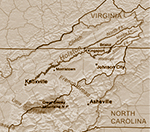
The Holston River flows from Kingsport to Knoxville.
map by Kmusser
The State of Franklin was an unrecognized, independent state in what is now eastern Tennessee. It was created in 1784 with the intent of becoming the fourteenth state. Its first capital was Jonesborough. It existed for about four and a half years and then North Carolina re-assumed control.
Landon Carter was born on Janary 29, 1760 in Virginia. Carter County, Tennessee was named for him and its county seat, Elizabethton, was named for his wife.
He married Elizabeth McLin on February 26, 1784. Elizabeth was born on July 9, 1765 in Virginia.
Alfred Moore Carter (1784),
John McLin Carter (1786),
Sarah Stuart Carter (1789),
William Blount Carter (1792),
George Washington Carter (1794),
Elizabeth Macklin Carter (1797) and
Mary Polly Carter (1799).
Landon Carter was a captain in the American Revolution. He served under Colonel John Sevier and Colonel Arthur Campbell in 1780 and 1781. He was in the battle of Boyd's Creek and in an expedition against the Cherokee.
Landon was a strong supporter of the State of Franklin and was secretary of the first Franklin convention.
Elizabeth died in 1842 at Washington County, Tennessee.
The Cherokeewere indigenous people who lived in the southern Appalachian mountains. European Americans called their towns in eastern Tennessee, the Overhill Towns. The towns included Chota, Tellico and Tanasi.
In 1776, the Cherokee planned to drive settlers out of the Washington District. The settlers were warned and stopped the first attack at Heaton's Station. The second attack was stopped at Fort Watauga. In response to these attacks, the militia burned Tuskegee and Citico.