“Remember, remember always, that all of us, and you and I especially, are descended from immigrants and revolutionists."
― Franklin D. Roosevelt
England
Charlestown, Middlesex County, Massachusetts
Dedham, Norfork County, Massachusetts
Weymouth, Norfork County, Massachusetts
Malden, Middlesex County, Massachusetts
Concord, Middlesex County, Massachusetts
Ralph and Thankful Shepherd and their children and Henry and Ann Collins and their children came to America together on the Abigail. She arrived in Boston about October 8, 1635. The passengers were infected with smallpox.
Middlesex County, Massachusetts was created on May 10, 1643. The county originally included Charlestown, Cambridge, Watertown, Sudbury, Concord, Woburn, Medford, Wayland, and Reading.
Colonial legislatures granted land to a group of settlers (proprietors) who chose how to divide the land. They had some rights of governance.
Chelmsford, Middlesex County, Massachusetts was incorporated in May, 1655
Rehoboth, Massachusetts was settled in 1643. It originally included included Seekonk, and parts of Attleboro, North Attleborough, Swansea and Somerset in Massachusetts, and East Providence, Barrington, Bristol, Warren, Pawtucket, Cumberland, and Woonsocket in Rhode Island.
During the wars with indigenous Americans, some European colonists were taken captive. They were killed, ransomed, or adopted into the tribe.
The rod or perch or pole is a surveyor's tool equal to 5 1⁄2 yards.
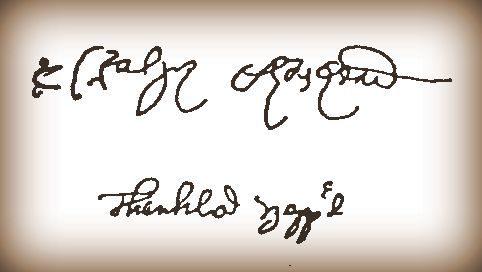
Ralph Shepard and his wife, Thanklord, married on May 21, 1632 in Saint Bride’s Church, London, England.
Their daughter, Sarah Shepard was born on August 6, 1633.
The young family left from Stepney, England and arrived Charlestown, Middlesex County County, Massachusetts in 1635. Ralph was 29, Thanks was 23 and Sarah was only three. They sailed on the Abigail.
The year after they arrived in Charlestown, they moved to Dedham where they lived for a short time. Ralph (Rafe Shepheard) attended the first town meeting which was held August 18, 1836. He received twelve acres of land. He signed the Covenant of Dedham in 1636.
On March 23, 1636/37 Ralph was granted a parcel of meadow in Dedham. On May 11, 1637 he received four acres of swampland. On July 28, 1638, he received additional land in Dedham to make up for his half lot.
July 23, 1643, Ralph Shepard is record as one of the original proprietors of Rehobeth, Massachusetts, but he was one of those who forfeited lots in Rehoboth for not fencing them or moving their families there.
On June 31, 1644, Ralph received a share of woodland at Weymouth. On June 9, 1645, he was granted a lot on the great plain.
The family moved to Malden, Massachusetts by 1650.
On April 19, 1651 Ralph bought an upland lot “lying by the Nort Springe on Mistik Syde" of five acres and four cow lots in Malden. He bought it from Dr. Richard Palgrave.
Jacob Shepard was born on June 16, 1653. Thomas married in 1658 in Malden, Tryal married in 1660 and John married in 1661 at Concord.
On March 5, 1664 they sold some land at Malden to Abraham Hill. In 1666 he bought 610 acres in Concord from Lt. Joseph Wheeler.
On March 25, 1666 he deeded 60 acres in Concord to Walter Power.
On July 7, 1666 they sold land some in Malden to Benjamin Bunker.
Isaac married in 1667 at Concord, Thanks married in 1669 at Chelmsford, and Abraham married in 1673.
In 1676 two of their sons, Isaac and Jacob were killed by indigenous warriors during King Philip’s War.
On Saturday, Feb. 12, 1675, the sons Isaac and Jacob were killed by the Indians on the south side of Quagana hill. They, at the time, were threshing grain in the barn on the Shepard homestead. Being aware of the perilous times,—this was during King Philip’s War—the sons had set their sister (niece?) Mary on the summit of the hill to watch for Indians.
The ground was covered with deep snow and the Indians traveled with snowshoes. Eluding the vigilance of Mary who was only about thirteen years old, they swooped down up on the Shepard barn before she was aware of their presence and slew Isaac and Jacob.
She was taken captive and carried to Nashawa,—now called Lancaster, or some place in that vicinity. During the first night after her capture she escaped and reached home the next morning. In the dead of night, Mary took a saddle from under the head of her Indian keeper who was sunk in sleep increased by ardent spirits, put the saddle on a horse which the Indians had stolen at Lancaster, mounted it, swam it across the Nashawa river, rode through the forest to her home.The leader of the Indian band is supposed to have been Netus, sometimes called Nipmuck Captain.(Ancestors and Descendants of Albro Dexter, p, 27-28)
The History of Concord also told the story:
The place of the tragedy was on the south side of Quagana Hill, and the persons slain and captured were children of Ralfe and Thanklord Shepard who went from Malden near a place since called Bell Rock to Concord village, where he bought of Lieut Joseph Wheeler of Concord 610 acres lying in the form of a triangle between the Indian plantation of Nashoba and that part of Chelmsford which is now Westford; Nagog pond forming the base of the triangle, the apex being two miles one-quarter and sixty rods north from the southwest end of Nagog pond.
The names of the persons slain and captured were Isaac, Jacob, and Mary.Isaac was born June 20, 1639, and married Mary Smedley, 1667. Jacob was born in 1653, and Mary the youngest of the family was born in 1660 or 1662.
When the Indians swooped down upon the Shepard homestead the ground was covered with snow to such a depth that snow shoes were used. The event happened on Saturday, and Isaac and Jacob were threshing in the barn. Being aware of the perilous times, they had set their sister on the summit of a hill to watch for Indians; but the savages eluded her vigilance and before she was aware of their presence she was captured and her brothers were slain.
Tradition does not inform us just where the girl was taken to; some think it was in the neighborhood of Lancaster, others that it was as far off as Brookfield, but wherever it was she soon escaped and returned home. Hubbard in his narrative of the Indian wars says of Mary Shepard that she strangely escaped away upon a horse that the Indians had taken from Lancaster a little while before. Tradition asserts that she escaped during the night following the day of her capture and arrived home the next morning.
Rev. Edmund Foster a former minister of Littleton in a "Century Sermon" preached in the year 1815, stated concerning the event that tradition says the girl was carried by the savages to Nashawa, now called Lancaster, or to some place in the neighborhood of it.
Samuel Gardner Drake in his notes on the "Old Indian Chronicle" says that the leader of the band who slew the Shepard brothers is supposed to have been Netus, the same who attacked the Eames family, and who was sometimes called the Nipmuck Captain. Netus was slain the 22nd of March following, by a company of men from Sudbury, who with some soldiers from Marlboro found him asleep with a company of Indians around their campfire. Foster says that in the dead of night as related by tradition, Mary Shepard took a saddle from under the head of her Indian keeper when sunk in sleep increased by the fumes of ardent spirit, put the saddle on a horse, mounted him, swam him across Nashawa river, and so escaped the hands of her captors and arrived safe to her relatives and friends.
In 1681 Ralph deeded part of his Concord lands to Abraham and part to Isaac.
Four of their children (Isaac, Trial, Abraham and Thanks) lived on farms contiguous to theirs.
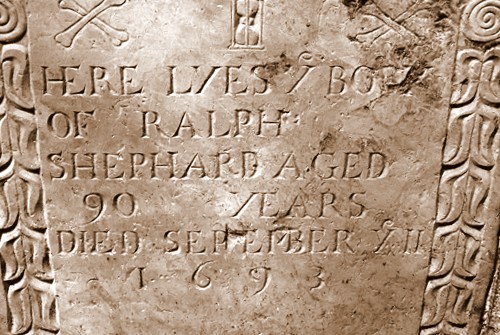
Ralph died in 1693 and Thankful died in 1681 or 1693. They are buried in Bell Rock Cemetery.
Daniel married in 1701.
Old Style Calendar
Before 1752 the year began on Lady Day, March 25th,. Dates between January 1st and March 24th were at the end of the year. Old Style (O.S.) and New Style (N.S.) are used to indicate whether the year has been adjusted. Often both dates are used.
Dedham, Norfolk County, Massachusetts was settled in 1635 by English Puritans.
Malden, Massachusetts was first settled in 1640. It was incorporated as a town in 1649 and as a city in 1881. Prior to 1649, it was part of Charlestown called Mystic Side.
European and indiginous American fought fierce battles, sometimes called the Indian Wars, as the Europeans expanded their territory.
Understand the Puritans better: Wicked Puritans of Essex County is a unique report on Puritan criminality that shatters the stereotype of the Puritan.
Concord, Middlesex County, Massachusetts was settled early by the English as a frontier outpost of the Massachusetts Bay Colony.
Some Puritans gave their children hortatory names (from the Latin for “encourage”) like Thankful, hoping that the children would live up to them. The names were used for several generations.