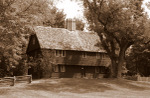
The settlement of New Meadows was incorporated as the Town of Topsfield in 1650. The church "gathered" on November 4, 1663. The third Meeting House was built in 1703 with Rev. Joseph Capen as pastor.
Michael and Mary Dwinnell married in Europe before 1668. The family's origins are not known. It could have been France, Scotland or Ireland.
They settled in Topsfield, Essex County, Massachusetts about 1660 where they were large landowners. They owned land from Wenham to Middleton, Massachusetts. They lived in Topsfield at the same time as the Isaac and Mary (Towne) Estey family and were there during the witch hysteria of 1692.
He (Michaell Donnell) took the oath of allegiance to King Charles II in Topsfield on December 18, 1678.
In 1684, Michael's wife was on the list of members in full Communion at the church in Topsfield when Joseph Capen was ordained. They (Michal Donnell) were taxed in Topsfield in 1688.
Topsfield Historical Collections Volume 11 related that
At a Lawfull meeting of ye Town of Topsfield the 2 day march 1702/8 . . . Michill Dwaniell & John Town are chosen hogringers. . .At a Lawfull and Generall meeting of ye Town of Topsfield on ye fourth Day of March 1706-7 . . . Thomas Perley and Micheal Dwaniel are Chosen Constables for ye year Insuing.
His will was dated January 29, 1710. The Compendium of American Genealogy, 1600s-1800s states that he died in 1713 or 1717 and his will was proved in March, 1717 and according to the Essex County Probate Index his will was filed on March 3, 1718 in Topsfield.
Michael made provisions for Mary, his widow in his will since as a married woman she was not able to own any property in her own name.
. . . my Son John Shall have ye Barn, only allowing his Mother so much of It as she shall have occasion for her own use, and Benefit during her Natural life. . .my Son John & Joseph shall keep for my wife Two Cows and a Horse. And Ten Sheep—my wife finding fodder for them—Also she shall have liberty of milking ye Cows in pasture.
Old Style Calendar
Before 1752 the year began on Lady Day, March 25th,. Dates between January 1st and March 24th were at the end of the year. Old Style (O.S.) and New Style (N.S.) are used to indicate whether the year has been adjusted. Often both dates are used.
King Charles II ruled England from
1660 to 1685.
ye is an archaic spelling of "the."
A constable was an elected official who was responsible for keeping the peace. His duties were more limited than the sheriff's. He apprehended and punished offenders, helped settle estates, and collected taxes.
The Huguenots were 16th and 17th century French protestants. About 500,000 Huguenots fled France because of religious persecution. They relocated to Protestant nations.
from Genealogical and Personal Memoirs, Volume 1
edited by William Richard Cutter
Michael Dwinell, immigrant ancestor, was born about 1640. Tradition differs as to the origin of the family, some saying it was Scotch, and others French Huguenot. one branch of the family has supposed that the Dwinells came from France, where a Count Dwinell was settled near La Rochelle. The spelling of the surname has always varied. Even at the present day we find his descendants called Dwinell, Dwinnell and Dwinel. The surname as written in the town records of Topsfield. where the pioneer settled, has the following variations; Dewnell, Duenell, Doenell, Douell, Dunell. Dwinnill. but the best early authority is that of Rev. Joseph Capen, of Topsfield. who spelled the name Dwinell on his records from 1684 to 1725.
Michael was also spelled in divers ways. Dwinell was a man of property. owning large tracts of land from Wenham to Middleton. Massachusetts. He died in 1717 and his will was proved in March of that year. He married Mary.
Children:
1. Mary. born 1668, married John Hovey and resided in Topsfield.
2. Michael. born 1670.
3. Thomas. born November, 1672. married, May 23. 1701, Dinah Brimsdell, of Lynn.
4. John born 1647, married
Mary Read, of Salem.
5. Elizabeth. born April, 1677, died unmarried October 29. 1759.
6. Magdalen. born 1679. married. March: 1703. James Holgate.
7. Joseph, born Januarv. 1682, married Prudence Curtis: drowned in attempting to swim the river in 1747
8. Susannah, born 1685. married, October 16. 1706. Nathaniel Hood. of Lynn.
In 1688, during the Glorious Revolution, the Protestant king and queen,William and Mary, took the English throne from Catholic King James II. The bloodless revolution profoundly impacted the American colonies.
Site of Michael Dwinell House, off Salem Street. About 600 feet off Salem street, and on the eastern side, in Willard A. Dwinell's old orchard pasture, may be seen the site of the Michael Dwinell two story house, which was built near the old Salem road that went through his land. Mr. Dwinell came from France, and is supposed to have come to this town about 1664. He was the ancestor of the Dwinell family here. Near this site, in the summer time, may be seen beautiful red roses of different shades. These bushes are supposed to have been here ever since he lived at this place. The house was not taxed after 1760.
Cellar Of Thomas Dwinell House, off Salem St. In the same pasture and about 150 feet in a southeasterly direction from the site of the Michael Dwinell house, may be plainly seen the cellar of the Thomas Dwinell house. This cellar is still quite deep. The house was taxed as late as 1765.
Essex County, Massachusetts was created on May 10, 1643 by the General Court of the Massachusetts Bay Colony, when it ordered "that the whole plantation within this jurisdiction be divided into four sheires."
Seals were used to authenticate documents and men were expected to have a personal die. Records in deed books are copies and signatures are usually in the clerk’s handwriting. The clerk drew a circle around the word “seal” to indicate that the original document was sealed.
ffrancis Pabody & Mary Pabody
To Michail Doniel
Sold bargained & warranted for, and in consideration of seventy Pounds, lawful currency, a certain Tract of Land being Devission Land, part whereof that purchased of John How, and part of it purchased of Isaac Comings, as by these several deeds under their hands, and seale doth, and may appear by my same Devission--The whole containing by estimation Fifty Acres be it more, or less--
Scituate, lyeing & being in Topsfield aforesaid on the South Syde of the River called Ipswich River,
being bounded toward the south east, partly by the Land of Joseph Porter
partly by the Land of Mr. Wm Perkins, and in
pt by Salem Line, towards the south East cove, common toward the North & West
bounded by the land of Edmund Cooane, and
toward the south West bounded by the Salem Line
Also the Fifth pt of a piece of meadow purchased of the Towne of Topsfield, also Ten Acres purchased of Isaac Comings yt of the undevided land bounded &c by land of Joseph Porter, Ensign Howlet and by the North east by Wenham meadows
Signed and delivered the 24th day of October in the twenty fourth year of the reigne of y Soveraigne Lord Charles the Second, by the Grace of God, of Great Britaine, ffrance and Ireland King, defender of the faith et cet Anno Domin 1672.
Witnessd acknowledged March 13, 1672
Robert Ford
Abraham Foster
before Dainiell Dennisson
Isaac Commings Senr
to Michaell Donell
deed recorded 10 March 1672
Deeding to him as assignee of ffrancis Pabody his right to the Teu Acres on the South side of Ipswish River, bounded as before, and on meadow called Pendleton's meadows.
Michael Dunwell, to Tobijah Perkins [son of William]
Entered May 4, 1695
Know all men by these presents, that I Michael Dunwell of Topsfield, in ye County of Essex in ye Massachusetts Bay, in New England have in Consideration of a Ten Acre Lott, assured to me by Tobijah Perkins of ye above Topsfield
Exchanged & do hereby exchange and sell unto ye said Tobijah his heirs, Executors, Administrators, or Assigns, that Ten Acre Lott,
being ye thirtieth Lott in number of ye Divided common, on ye south side of Ipswich River, which I bought of Lieut [Francis] Peabody,
together with Five Shares, in the parcel of land, which is yet undevided and Lyeth, between Joseph Porters, and Wenham Meadow
to have, and to Hold ... in witness whereof, I have set my hand, and seale, this fourteenth day of September 1674
American colonists continued to use British monetary units, namely the pound, shilling and pence for which £1 (orli) equalled 20s and 1s equalled 12d. In 1792 the dollar was established as the basic unit of currency.
Wenham was first settled by English Puritans. The church was formed in 1644 with John Fiske as pastor.
New England Families, Genealogical and Memorial: A Record of the Achievements of Her People in the Making of Commonwealths and the Founding of a Nation by William Richard Cutter, Lewis Historical Pub. Co., 1915
Tradition differs as to the origin of this family, some saying it was Scotch, and others French Huguenot. One branch of the family has supposed that the Dwinells came from France, where a Count Dwinell was settled near La Rochelle. The spelling of the surname has always varied. Even at the present day we find descendants called Dwinell, Dwinnell and Dwinel. The surname as written in the town records of Topsfield, where the pioneer settled, has the following variations: Dwenell, Duenell, Doenell, Donell, Dunell, Dwinnill. But the best authority is that of Rev. Joseph Capen, of Topsfield, who spelled the name Dwinell on his records from 1684 to 1725. The name Michael was also spelled in divers ways.
(I) Michael Dwinell (Dwinnell), the earliest of whom we have knowledge, probably born about 1640, appears in Topsfield, Massachusetts, where he was a man of property, owning large tracts of land, also in Wenham and Middleton. His will made January 29, 1711, was proved in March, 1718, indicating that he died about the beginning of the latter year. He married, in 1667, Mary Read, whose parentage has not been discovered. Children: Mary, born January 21, 1668; Michael, December 5, 1670; Thomas, mentioned below; Isaac, December 16, 1674; Elizabeth, April 17, 1677; Magdelen, February 24, 1679; Joseph, January 26, 1682; Susanna, September 15, 1685; Johanna, 1688.
Wenham, Essex County, Massachusetts was settled in 1636. The first settlers called it Enon or Salem Village. It was officially set off from the Town of Salem on May 10, 1643.